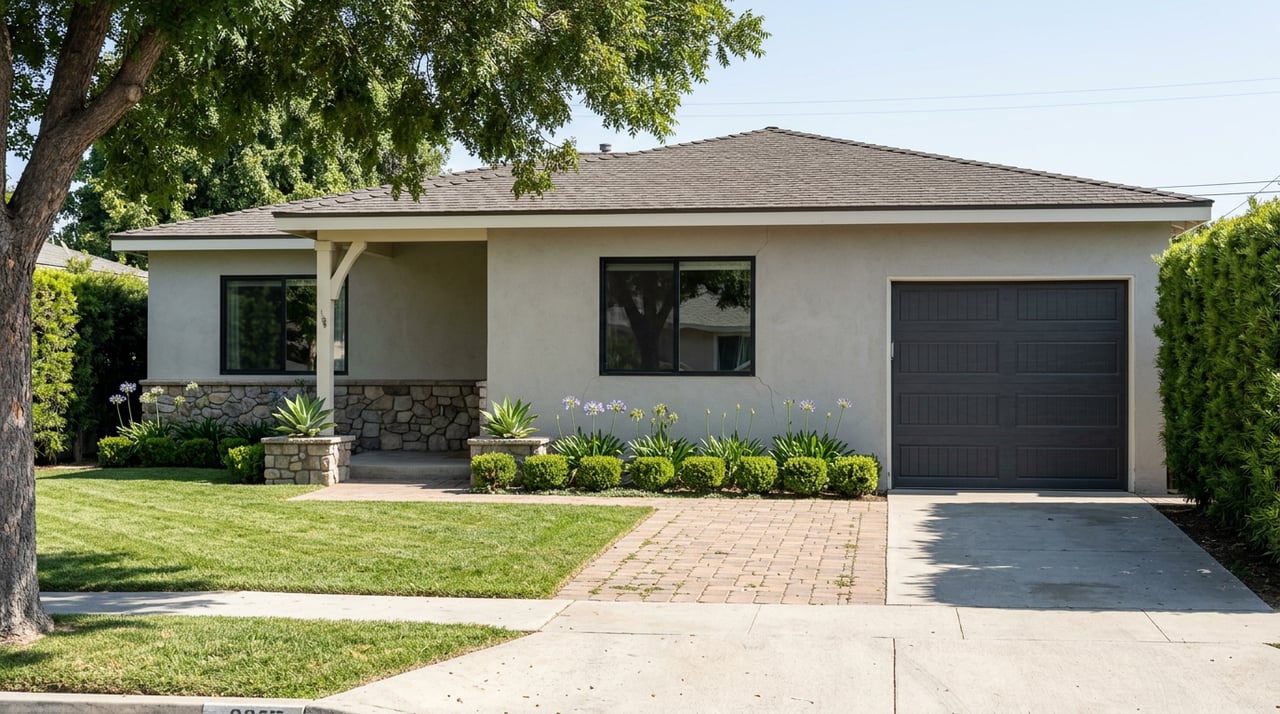
Two Irvine listings, ten minutes apart by car, same square footage, both priced right around $1.5 million. One sits in Turtle Rock, a village built out before the city started financing new neighborhoods with bonds. The other sits in a Great Park neighborhood finished in the last several years. The listing sheets read almost identically. The monthly cost of owning either one does not.
As of mid-2026, the median Irvine home sale price sits around $1.54 million. That number gets repeated on every portal and every open house flyer, and it tells a buyer almost nothing about what two homes at that price actually cost to carry each month. The gap comes down to a line item most buyers don't read until they're deep in escrow: the Mello-Roos special tax.
The 1% you were told about, and the number that actually shows up
California caps the base property tax rate at 1% of assessed value under Proposition 13, and most buyers know that going in. What catches people off guard is the effective rate, the number that includes everything stacked on top of that base once local bonds and special taxes are added in.
In an older Irvine village with no Mello-Roos, the effective rate typically runs about 1.05% to 1.1%. On a $1.5 million purchase, that puts the annual tax bill around $16,200. In a newer village where Mello-Roos is layered in, market estimates for Irvine put the effective rate closer to 1.8%, which pushes that same $1.5 million purchase to roughly $27,000 a year. That's a gap of about $10,800 annually, or $900 a month, on two homes with an identical price tag.
A separate, independent check on the same pattern comes from Ownwell, a property tax data platform that tracks effective rates by ZIP code. It found homes in Irvine's 92618 ZIP carrying a median effective rate of 1.42%, compared with 1.05% in 92617, a spread of more than a third of a percentage point between neighborhoods in the same city. Different data source, same shape of gap.
Why the split runs along a build date, not a neighborhood name
Irvine built out in phases over five decades, and the financing tool changed partway through. Older villages were built before Community Facilities District financing became standard practice in Orange County. Newer master-planned phases paid for their roads, parks, and schools by issuing bonds through a CFD, and buyers in those phases repay that debt through the Mello-Roos line on their annual tax bill.
The City of Irvine publishes its own list of active districts, and it reads like a map of the city's growth: CFD No. 2004-1 covers Central Park, CFD No. 2005-2 covers Columbus Grove, and CFD No. 2013-3, the newest on the list, covers the Great Park. Alongside those sit assessment and reassessment districts for Woodbury, Portola Springs, Orchard Hills, Stonegate, Laguna Altura, and Quail Hill/Shady Canyon/Turtle Ridge.
Market guides consistently describe Northwood, Turtle Rock, Woodbridge, University Park, and Oak Creek as villages with little to no Mello-Roos, since they predate this financing approach. But the city's own list includes an assessment district for Oak Creek, District 94-13, which is worth sitting with for a second. If a village that's routinely described as Mello-Roos-light still shows up on the city's active district list, that's not a reason to distrust either source. It's a reason to stop treating a neighborhood name as a substitute for pulling the actual parcel record before you assume anything about what a specific home costs to carry.
| Village or phase | District on file with the City of Irvine | What it means for a buyer |
|---|---|---|
| Northwood, Turtle Rock, Woodbridge, University Park | None listed | Commonly described as Mello-Roos-light, generally the lowest carrying cost |
| Oak Creek | Assessment District 94-13 | Often grouped with the older villages, but a district exists, so verify the parcel |
| Woodbury | Assessment District 03-19 | Active CFD-era village |
| Portola Springs | Reassessment District 04-20, CFD formed in 2009 | Fixed special tax, community reporting clusters it near $3,800 a year, still well inside its bond term |
| Orchard Hills | Reassessment District 05-21 | Active CFD |
| Stonegate | Assessment District 07-22 | Active CFD |
| Great Park Neighborhoods | CFD No. 2013-3, the city's newest | Highest reported range, some buyers describe the charge scaling with home square footage rather than a flat per-parcel amount |
The bond doesn't stop when you'd expect
Mello-Roos bonds are typically structured to run 20 to 40 years from the date the district was formed, and the special tax is scheduled to end, or in some districts step down, once those bonds are repaid. That sounds like a countdown clock buyers can plan around. In practice, the remaining term varies enormously depending on when a given village was built.
Portola Springs' CFD was formed in 2009, which puts it roughly 13 to 17 years into a 30-year term as of 2026, meaning a meaningful amount of the obligation still remains no matter when you buy in. Great Park's district, formed in 2013, is younger still. And unlike the base 1% tax, which is capped from rising more than 2% a year under Prop 13, the Mello-Roos special tax isn't tied to assessed value at all. It's a fixed dollar amount set when the district formed, and the CFD's own governing formula typically allows it to climb by roughly 2% a year regardless of what the home is worth. It won't shrink if the market softens, because it was never based on the market to begin with.
A lower offer price reduces the base 1% tax proportionally. It does nothing to the Mello-Roos line, because that charge was never based on price in the first place.
That's worth sitting with if you're the kind of buyer who assumes a negotiated discount fixes your total carrying cost. On a home with no CFD, a lower price does bring the tax bill down with it. On a home inside an active district, the special tax is fixed to the parcel, not the sale price, and it rides along at the same dollar amount whether you paid list or negotiated ten percent off.
What it does to your loan approval, not just your budget
Mortgage underwriters treat Mello-Roos the same way they treat a mortgage payment or an HOA due: it counts against your debt-to-income ratio at approval time. A $3,600 annual special tax adds roughly $300 to your qualifying monthly costs, and that can trim tens of thousands of dollars off the loan amount a lender is willing to approve, even though the tax itself never touches your mortgage principal. Two buyers with identical income and identical down payments can qualify for meaningfully different purchase prices depending on which Irvine village they're shopping in, before either one has made an offer.
How to actually verify it before you write an offer
The only reliable way to know what a specific home costs to carry is to check the parcel, not the village reputation.
- Pull the seller's current secured property tax bill and look for a line item labeled "Community Facilities District," "Special Tax," or a CFD number.
- Look up the parcel by APN through the Orange County Treasurer-Tax Collector to confirm the current installment amounts. Bills are paid in two installments, the first due November 1 and delinquent after December 10, the second due February 1 and delinquent after April 10, with a 10% penalty applied after each delinquency date.
- Cross-check the village against the City of Irvine's own list of active districts to confirm which numbered CFD, if any, actually covers it.
- Ask for the Rate and Method of Apportionment document if you want the exact escalator formula and the projected payoff date, since two homes in the same village can carry different amounts depending on lot size or floor plan.
- Request the preliminary title report, which will show any special tax lien recorded directly against the parcel.
None of this should scare a buyer off Irvine. The infrastructure that Mello-Roos funds is the reason these villages have the parks, schools, and roads they do. It just means the sale price on its own isn't a complete number, and the neighborhood name isn't a reliable stand-in for what's actually on file with the county.
FAQ
Does Mello-Roos ever go away? Yes, once the underlying bonds are repaid, typically after 20 to 40 years. Some districts phase the charge down or eliminate it at payoff, while others convert a portion into an ongoing, smaller maintenance fee. The exact outcome depends on that district's formation documents.
Is Mello-Roos tax deductible? Generally, the ad valorem portion of a property tax bill, the part based on assessed value, is deductible up to the federal SALT cap, which rose to $40,000 for 2026. The flat special-tax portion typically is not, since it isn't tied to the home's value. Confirm the specifics with a tax professional before filing.
Can I negotiate the Mello-Roos amount when I make an offer? No. It's set by the CFD's formation documents and attached to the parcel, not the sale price. That's exactly why it survives a lower offer the base property tax would otherwise respond to.
If you're comparing Irvine villages and want the actual Mello-Roos figure pulled for a specific address before you write an offer, reach out to Dina Gonzalez to register for a walkthrough of the real numbers behind any listing you're considering.